Why buy retro consoles from Japan
Japan kept its games. A culture of trading in used goods at specialist shops — and keeping boxes, manuals and cables — means Japanese secondhand stock is plentiful and often in remarkably good condition for its age.
Selection you can't find at home. Consoles and games that sold in small numbers overseas were mass-market products in Japan. Japanese versions are frequently easier to find — and in better condition — than local equivalents, and some games and hardware variants were never released outside Japan at all.
Condition grading is taken seriously. Japanese used-goods shops grade and describe stock carefully, and individual sellers on Japanese marketplaces generally follow the same habit. A listing that says an item works usually means it was tested. Section 4 below explains how to read those descriptions so you get what you expect.
Boxes and completeness. Boxed consoles and complete-in-box games, which command a premium elsewhere, are a normal part of the Japanese used market rather than a rarity.
Region and voltage: the two checks that matter
Most disappointment with imported retro hardware comes from skipping these two checks. Neither is complicated once you know what applies to the console you want.
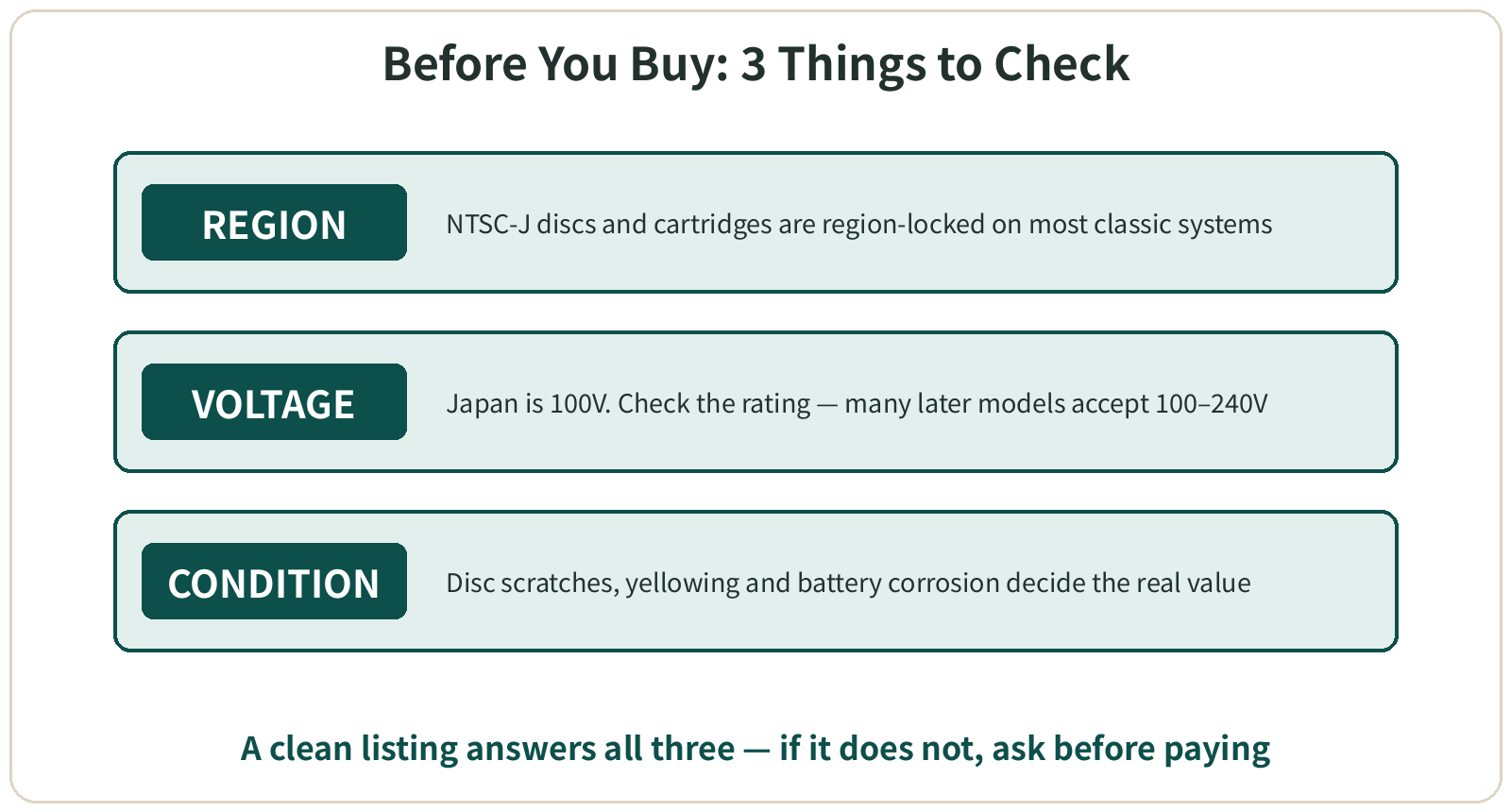
Region locks depend on the era. Cartridge-based consoles from the 8-bit and 16-bit era often used physical cartridge shapes and lockout chips to separate regions — a Japanese cartridge may not fit, or may not run, in an overseas console without an adapter or modification. Disc-based consoles generally enforced region coding in software. Handhelds are the friendly exception in many cases: several major handheld lines are region-free, so Japanese games run on overseas hardware and the reverse. The rule is simple — check the specific console and game combination before buying, every time. Do not assume.
Japanese hardware runs on 100 volts. Japan's mains supply is 100V, and original Japanese power adapters were made for it. In North America (120V), an original Japanese adapter is often used as-is by collectors, but it is running above its rating and a step-down transformer is the cautious option. In Europe, the UK and Australia (220–240V), plugging in an original Japanese adapter directly can destroy it and the console — use a proper step-down converter, or a modern replacement power supply rated for your local voltage and matched to the console. When a listing says "no adapter included," budget for one.
Video output differs too. Japanese consoles output NTSC video. Modern TVs and upscalers usually handle this without trouble, but very old Japanese hardware paired with a PAL-only display can be a problem. If you plan to use a CRT television, confirm it accepts an NTSC signal.
Three ways to buy
New-old-stock and reissues come from shops; the real depth of the market is used. All three routes below are used by collectors.
Direct international shops
Japanese retailers that ship overseas, such as CDJapan, carry games, consoles and related goods with English checkout and export handled for you. Stock of true retro hardware is limited compared with the used market, but this is the lowest-risk route for the items they do carry, and the natural place for new releases and reissues.
Used consoles on eBay
Japanese sellers list large numbers of used consoles and games on eBay, with photos of the actual item and English descriptions aimed at overseas buyers. This is usually the easiest way to compare condition and price across many units of the same console. Check whether the listing says the item was tested, what cables and controllers are included, and what shipping costs — consoles are heavy enough that shipping is a real part of the total.
Proxy buying services
The deepest stock sits in Japanese domestic shops and auction sites that don't ship abroad. A proxy service buys on your behalf and forwards the parcel to you. This opens up specialist retro shops and Japanese auctions — the best hunting ground for specific titles and boxed items. Expect service fees plus two legs of shipping, and check the fee schedule and consolidation options before bidding or ordering.
Which route should you choose?
New or reissued item → direct shop. A common used console with plenty of listings → eBay, comparing tested units. A specific title, boxed item or auction find → proxy service. In every case, compare the total — item, shipping, fees, and likely import charges — not the item price alone.
How to read Japanese used-item condition
Japanese listings describe condition in a fairly consistent vocabulary. Knowing a few key ideas will save you from most bad surprises.
Look for the tested / untested line first. The single most important distinction is whether the item was actually tested. Listings say things equivalent to "operation confirmed" for tested items — and, importantly, Japanese sellers use a term often translated as "junk" for untested or faulty items sold as-is. "Junk" in a Japanese listing does not mean trash; it means no guarantee — it might work, it might not, and the price reflects the gamble. Never pay a tested-item price for a junk listing.
Condition grades describe cosmetics, not function. Grades (often letter ranks, or words like "beautiful item" down to "noticeable scratches and yellowing") describe appearance: scratches, discoloration of the plastic, sun-fading, and whether the box and manual are included. Function is stated separately — read both halves of the description.
What's in the box is spelled out. Japanese listings typically enumerate exactly what's included: console only, or console plus controller, cables, adapter, box and manual. If a cable or adapter isn't listed, assume it isn't included and budget accordingly — this matters with retro hardware, where the correct original adapter can be half the battle (see the voltage notes above).
Photos are of the actual item, usually. Japanese marketplace sellers generally photograph the exact unit for sale. Scratches and yellowing visible in photos are considered disclosed. Zoom in.
Customs and shipping notes
US buyers: low-value parcels are no longer duty-free. The US removed the $800 de minimis exemption on August 29, 2025, so retro consoles shipped from Japan can now incur import duties regardless of value, plus possible carrier handling fees. Factor this into your budget before ordering — especially on eBay and proxy purchases, where duties are typically collected on delivery rather than at checkout. Other countries have their own import VAT or GST rules; check yours and treat any figure as an estimate.
Consoles are heavy; shipping matters. A boxed console with controllers and cables is one of the heavier parcels in retro collecting. With proxy services, look for consolidation (combining several purchases into one parcel) to keep the international shipping leg reasonable.